Understanding what regulations impact automotive lighting systems requires more than listing standards. It requires tracing how each rule changes a lamp’s shape, beam pattern, color, testing process, and approval pathway.
In the United States, Federal Motor Vehicle Safety Standard No. 108 governs headlights, turn signals, brake lamps, reflectors, and other lighting equipment. The National Highway Traffic Safety Administration uses this framework to define performance and installation requirements. In Europe and many international markets, UNECE Regulation No. 48 addresses lighting installation, while Regulations Nos. 112, 123, and 149 cover different headlamp technologies and adaptive systems. These rules can affect software-controlled beams as much as physical components.
The safety stakes are measurable. The Insurance Institute for Highway Safety reported that vehicles with the best-rated headlights had substantially lower nighttime crash rates than vehicles with poor-rated systems. Its testing also exposed uneven illumination, glare, and weak visibility on curved roads. Small differences matter.
“Headlights are one of the most important safety features on a vehicle,” said David Harkey, president of IIHS. That statement sounds simple. It is not.
Manufacturers must also consider photometric tests, electromagnetic compatibility, automatic leveling, cleaning systems, and market-specific approval procedures. A lamp approved in one jurisdiction may still require redesign elsewhere. Compliance does not guarantee perfect real-world performance. Rain, dirt, aging LEDs, and driver behavior remain difficult variables.
That gap deserves attention. Regulations create a safety baseline, but engineering judgment must address conditions laboratory tests cannot fully reproduce.
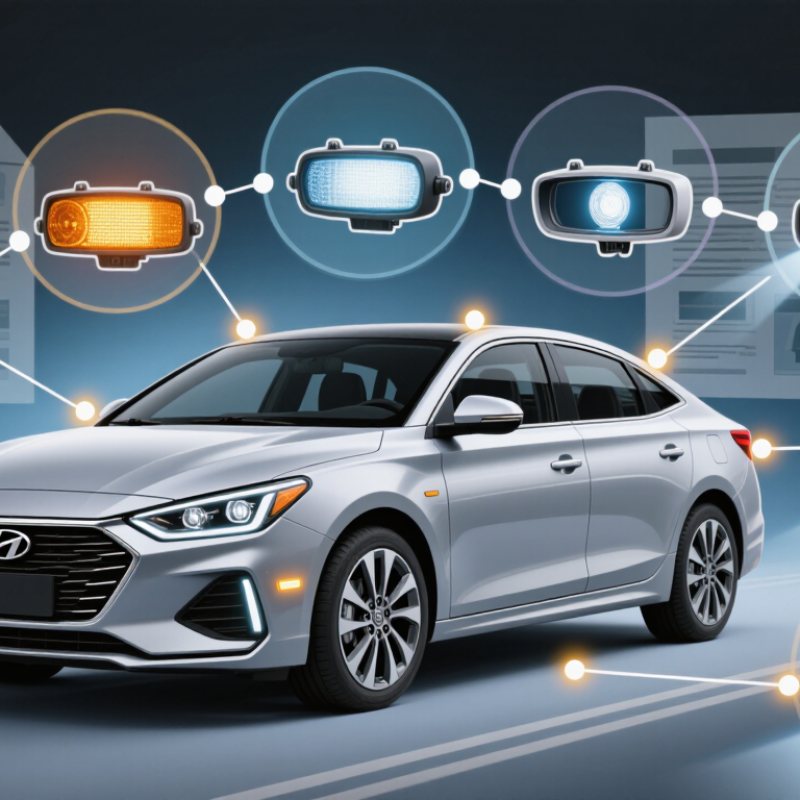
Automotive lighting regulations shape vehicle design from the first drawing. They define where lamps may sit, how brightly they must shine, and which colors are permitted. In the United States, Federal Motor Vehicle Safety Standard 108 covers lamps, reflective devices, and associated equipment. In many other markets, United Nations regulations guide installation, approval, and performance requirements. The applicable rules depend on the vehicle category and sales region.
Design teams must verify beam patterns, visibility angles, mounting height, spacing, and activation logic. Headlamps need controlled illumination without creating excessive glare for approaching drivers. Turn signals require recognizable color, timing, and separation from nearby lamps. Rear lamps must remain visible when viewed from specified angles. Small details matter. A slightly altered lens can change photometric results.
Adaptive and automatic lighting adds another layer of scrutiny. Engineers may need to document failure warnings, manual overrides, cleaning performance, and electronic compatibility. Testing often combines laboratory measurements with vehicle-level checks on prototypes. A drawing can pass review and still fail after vibration, temperature changes, or production tolerances. That is easy to underestimate.
Regulatory work also requires traceable records, approved components, and consistent manufacturing controls. Requirements can change, and regional interpretations are not always identical. A reliable process checks current regulations before freezing the design. No checklist is perfect. Human review still matters, especially when styling goals compete with visibility, glare control, and practical service access.
What Regulations Impact Automotive Lighting Systems?
Global standards classify vehicle lamps by their function, position, color, and photometric performance. Headlamps illuminate the road, while signal lamps communicate movement to nearby road users. Rear lamps usually display red light, and reversing lamps commonly emit white light. The details matter.
Regulatory systems define where each lamp may be installed, how bright it should appear, and when it must operate. They also control beam patterns, visibility angles, electrical safety, markings, and testing procedures. UNECE regulations often use type approval and detailed laboratory measurements. Other regions may follow national vehicle standards with different certification routes. These differences can affect one lamp design across several markets.
Engineers normally verify luminous intensity at multiple test points, not only at the brightest area. They inspect glare, color coordinates, mounting height, spacing, and automatic activation logic. A lamp can pass one optical test yet fail after installation changes. That is where practical experience becomes important. Road vibration, temperature, moisture, and lens aging may alter performance over time. Standards address many risks, but not every real-world condition. Designers should therefore treat compliance as an ongoing engineering process, not a final paperwork exercise. Classification also deserves review when a lamp combines functions, because a small housing change may influence its legal category.
Automotive lighting must satisfy technical rules before it reaches public roads. UNECE Regulation No. 48 defines installation requirements, including lamp position, spacing, visibility angles, and operating conditions. Regulation No. 112 covers headlamp photometry, while Regulation No. 123 addresses adaptive front-lighting systems. In the United States, FMVSS No. 108 specifies performance, equipment, mounting, and activation requirements.
Photometric testing is central. Engineers measure beam intensity, cutoff sharpness, color coordinates, and glare at controlled angles. Low-beam lamps must illuminate the road without exposing approaching drivers to excessive brightness.
Lighting functions also need reliable telltales and failure warnings. SAE J575 provides laboratory procedures for vibration, moisture, corrosion, temperature, and mechanical durability. These tests often reveal weaknesses hidden during normal workshop checks. Sealing may look adequate. It may still fail after repeated thermal cycling.
Modern systems add software and communication risks. Adaptive beams require diagnostic controls, safe fallback behavior, and electromagnetic compatibility testing. ISO 26262 also guides functional-safety processes when lighting faults could create hazardous conditions.
NHTSA reported 7,522 pedestrian fatalities in the United States during 2022, according to Traffic Safety Facts.
That figure does not prove lighting caused those crashes, but it reinforces the value of measurable visibility and predictable signaling. A practical validation plan should test clean lenses, road dust, rain, low voltage, and sensor blockage. Real roads are less orderly than laboratories.
Automotive lighting systems are tested against safety and compliance requirements before entering public roads. Requirements vary by country, vehicle type, and lighting function. Engineers begin by reviewing applicable national or regional rules. Photometric testing measures brightness, beam shape, color, and light distribution. Special instruments check whether low beams protect oncoming drivers from glare. High beams must provide useful distance without creating excessive discomfort. Small alignment errors can matter.
Safety testing does not end inside the laboratory. Vibration rigs simulate rough roads, while water spray tests examine sealing around lenses and connectors. Thermal cycling exposes weaknesses caused by repeated heating and cooling. Electrical tests examine voltage changes, wiring faults, electromagnetic interference, and control responses. Some faults appear only after thousands of cycles. That is easy to underestimate.
Compliance also depends on traceable records and repeatable methods. Test laboratories document equipment calibration, environmental conditions, sample identification, and measured results. Independent review can challenge optimistic interpretations. A road test may reveal reflections, delayed switching, or poor visibility during rain. Still, no test plan captures every real-world situation. An overlooked mounting tolerance or software interaction can change performance. That gap deserves honest review before production approval.
Regulatory changes are reshaping vehicle lighting faster than many development teams expected. Traditional rules focused on beam pattern, brightness, color, and lamp placement. Newer requirements increasingly address adaptive driving beams, automatic leveling, daytime visibility, and glare control. These systems must improve the driver’s view without disturbing approaching road users.
Testing is becoming more realistic. Authorities are examining lighting performance across curves, weather conditions, traffic scenes, and software-controlled functions. A lamp may pass a static laboratory test yet behave differently on a wet road. That gap deserves attention. Engineers now need traceable calibration data, repeatable software validation, and clear failure responses. A lighting controller should enter a safe state when sensors become blocked or communication fails.
The future will also involve stronger links between lighting, connectivity, and vehicle automation. Regulations may require better cybersecurity controls, update records, and evidence that software changes do not alter approved photometric performance. Energy use matters too, especially as electric vehicles place greater value on efficient systems. In practice, compliance teams should involve regulatory specialists early, not after hardware is frozen. That approach costs time upfront. It can prevent expensive redesigns later. Yet uncertainty remains, because regional rules do not always develop at the same speed. Manufacturers must monitor local requirements continuously and document every design decision.
| Market or Authority | Regulation or Standard | Primary Lighting Scope | Key Compliance Dimensions | Impact on Vehicle Design | Future Direction | Official Reference |
|---|---|---|---|---|---|---|
| United Nations Economic Commission for Europe International type-approval system |
UN Regulation No. 48 Installation of lighting and light-signalling devices |
Installation of headlamps, daytime running lamps, direction indicators, position lamps, stop lamps, rear fog lamps, reversing lamps, and other required or permitted devices. | Number and type of lamps, mounting height, lateral and longitudinal position, geometric visibility, electrical connections, tell-tales, and operating conditions. | Controls exterior styling, lamp packaging, automatic activation logic, and the integration of lighting functions into vehicle control systems. | Greater use of electronically controlled, adaptive, and networked lighting functions while retaining defined installation and visibility limits. | UNECE vehicle regulations |
| United Nations Economic Commission for Europe | UN Regulation No. 149 Road illumination devices |
Headlamps and other devices providing road illumination, including systems using LED modules, gas-discharge sources, or other approved light sources. | Beam pattern, luminous intensity distribution, color, photometric test points, marking, approval identification, and compatibility with the relevant installation rules. | Requires optical development to be validated through prescribed photometric measurements rather than by nominal light output alone. | Supports more advanced beam-control functions, including adaptive road illumination, provided glare control and photometric limits are maintained. | UNECE Regulation No. 149 |
| United Nations Economic Commission for Europe | UN Regulation No. 148 Light-signalling devices |
Direction indicators, position lamps, stop lamps, daytime running lamps, rear fog lamps, reversing lamps, and related signalling functions. | Photometric performance, emitted color, visibility angles, activation behavior, failure indication, lamp grouping, and approval markings. | Influences lamp segmentation, signature lighting, combined functions, and the control software responsible for signaling sequences. | Encourages multifunctional lamp assemblies while requiring unambiguous signaling and stable performance across operating conditions. | UNECE Regulation No. 148 |
| United Nations Economic Commission for Europe | UN Regulation No. 10 Electromagnetic compatibility |
Electronic lighting modules, control units, communication interfaces, and vehicle electrical systems that may emit or be affected by electromagnetic energy. | Radiated and conducted emissions, immunity, transient behavior, charging-related interference, and the effect of electronic control systems on vehicle functions. | Requires EMC validation for LED drivers, matrix control units, sensors, networked modules, and software-controlled dimming or switching functions. | Becomes increasingly important as lighting systems use higher computing content, zonal vehicle networks, and connected control architectures. | UNECE Regulation No. 10 |
| European Union EU type-approval framework |
Regulation (EU) 2018/858 Type approval and market surveillance |
Approval, conformity of production, market surveillance, and mutual recognition of vehicle systems, including lighting equipment covered by applicable technical regulations. | Technical-service testing, documentation, production conformity, approval extensions, recalls, and market-surveillance obligations. | Makes regulatory documentation, traceability, production consistency, and change management as important as the initial optical design. | Strengthens lifecycle compliance and increases the importance of documented software, hardware, and component changes. | EUR-Lex: Regulation (EU) 2018/858 |
| United States Federal motor vehicle safety system |
FMVSS No. 108 Lamps, reflective devices, and associated equipment |
Required and permitted lamps, reflective devices, headlighting systems, signaling devices, and associated equipment for covered motor vehicles and trailers. | Location, visibility, color, photometry, activation, tell-tales, replaceable light sources, marking, and performance requirements specified in the standard. | Requires self-certification and testing against U.S. performance requirements; packaging and control strategies must satisfy U.S.-specific provisions. | A 2022 amendment created a regulatory pathway for adaptive driving beam headlighting under specified performance conditions, supporting wider use of controlled high-beam functions. | U.S. eCFR: FMVSS No. 108 |
| China National vehicle standards system |
GB 4785 Requirements for the installation of exterior lighting and light-signalling devices |
Installation requirements for exterior lamps and signaling devices on motor vehicles and trailers. | Lamp quantity, mounting location, visibility, color, operating conditions, geometric requirements, and interaction with other vehicle lighting functions. | Requires market-specific engineering validation because installation rules and approval documentation may not be identical to UNECE or U.S. requirements. | Promotes more structured integration of LED, adaptive, and electronically managed functions within national type-approval procedures. | Chinese National Standards Platform |
| Global lighting market Cross-market engineering consideration |
Photometry, color, and glare-control requirements | Low-beam and high-beam performance, daytime running lamps, signaling functions, adaptive beam systems, and decorative or communication-related exterior lighting. | Luminous intensity distribution, visibility to other road users, color coordinates, glare limitation, failure behavior, thermal stability, and performance over voltage and temperature ranges. | Encourages optical simulation, closed-loop testing, thermal management, sensor validation, and robust software calibration before approval. | Future systems will increasingly combine cameras, sensors, software, and individually controlled light sources while maintaining predictable road-user communication. | UNECE WP.29 resources |
Lamps are classified by function, position, color, and measured light performance. Headlamps illuminate roads. Signal lamps communicate movement.
Rear lamps usually show red light. Reversing lamps commonly emit white light. Other colors depend on function and location.
Regulations control mounting height, spacing, visibility angles, beam direction, brightness, and activation timing. Small housing changes can matter.
Engineers measure light intensity at several test points, not only the brightest area. They also check glare and color coordinates.
Yes. Installation changes can alter beam alignment, visibility, or glare. A laboratory pass does not guarantee perfect road performance.
Vibration, heat, moisture, road spray, and aging lenses may change output. Standards cannot predict every condition.
New rules increasingly address adaptive beams, automatic leveling, daytime visibility, glare control, and software-controlled functions.
The controller should enter a safe state when sensors are blocked or communication fails. Failure behavior needs repeatable testing.
Software changes can affect approved beam performance, activation logic, and safety responses. Teams should record updates and validate each change.
Yes. Regional rules may develop at different speeds. Continuous monitoring is safer, though teams may still overlook practical road conditions.
Understanding what regulations impact automotive lighting systems is essential for designing vehicles that are safe, visible, and suitable for different markets. This overview explains how national and international requirements classify lamps, define their permitted functions, and control details such as color, brightness, positioning, beam direction, and activation. It also examines the technical expectations for headlamps, signal lamps, daytime running lights, rear lighting, and adaptive systems, while highlighting the importance of electromagnetic compatibility, durability, and reliable performance in challenging weather and road conditions.
The article further describes how lighting systems are evaluated through laboratory measurements, photometric testing, installation checks, environmental trials, and production-quality controls. Finally, it considers regulatory developments influencing the future of vehicle lighting, including advanced adaptive functions, automated beam management, energy efficiency, software-controlled features, and clearer requirements for emerging technologies. Staying informed about these changes helps manufacturers and engineers create lighting systems that support road safety, meet compliance obligations, and remain adaptable across evolving transportation standards.

EV Light